
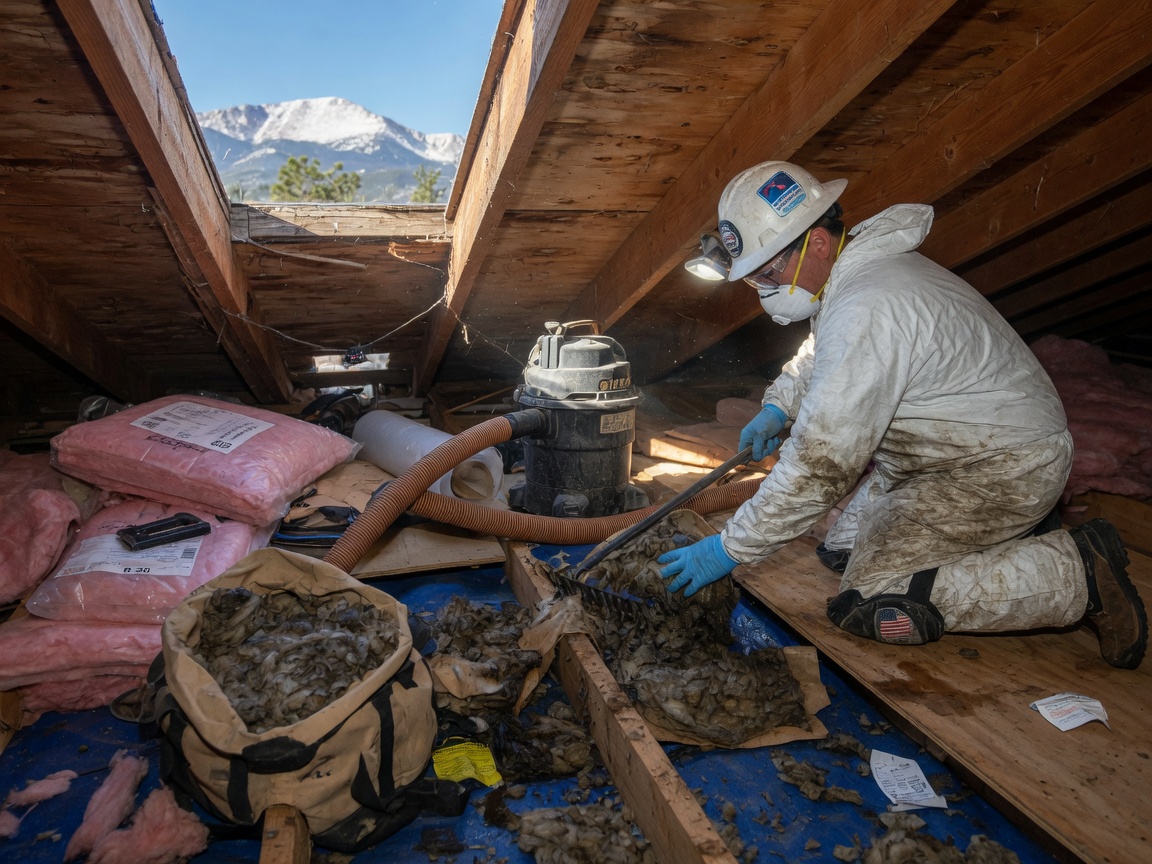
Colorado Springs homes built before the 1980s in Old Colorado City and Manitou Springs often contain fiberglass batts or loose-fill cellulose that trap water after pipe bursts or roof leaks. Once saturated, these materials lose R-value and promote mold growth within 48 hours in the region's cold winters. Removal requires negative-air machines and HEPA filtration to prevent spores from migrating into living spaces, especially in two-story Broadmoor properties where attic access is limited. Technicians must also check for hidden moisture in knee walls and around chimney chases near Pikes Peak foothills.
Semi-arid high-plains conditions create unique challenges: hot summer storms can drive water under eaves in Briargate and Rockrimmon, while winter freeze-thaw cycles in Security-Widefield and Fountain crack supply lines above insulation. Wet cellulose compacts and sags, blocking soffit vents and worsening ice dam issues. Replacement must use vapor-retardant materials rated for 6,000-foot elevation to avoid condensation problems when temperatures swing 40 degrees in a single day. Local code requires permits for work affecting more than 50 square feet in El Paso County.
Crawl spaces under 1970s ranch homes near Cheyenne Mountain and the United States Air Force Academy frequently hold standing water after heavy runoff. Removing wet insulation here demands dehumidification to 45 percent RH before new material is installed, or residual moisture will wick into floor joists. Technicians inspect for asbestos in older vermiculite layers common in Academy-area housing stock and coordinate with utility locates before cutting access panels.
Technician insight
In Colorado Springs the thing that catches most people out with Wet Insulation Removal & Replacement is how fast cold winter air in Manitou Springs and Broadmoor turns a small pipe leak into widespread attic saturation because older homes lack proper ridge venting.
Old Colorado City Attic Job
A 1940s home near Old Colorado City had a slow roof leak that soaked cellulose insulation above the master bedroom. We mapped moisture extending into two knee walls, removed 180 square feet of wet material under containment, dried the space, and reinstalled new insulation rated for the elevation before winter freeze-thaw cycles began.
Wet Insulation Removal & Replacement Services We Offer
✓Attic Wet Insulation Removal
Extract saturated fiberglass or cellulose from Colorado Springs attics after leaks, then install new material matched to local climate zones.
✓Wall Cavity Insulation Extraction
Remove water-damaged insulation from exterior walls in Broadmoor and Briargate homes without full drywall demolition using targeted access points.
✓Crawl Space Insulation Replacement
Clear wet insulation from underfloor areas common in El Paso County ranches, dry the space, and reinstall vapor-barrier protected material.
✓Basement Wet Insulation Cleanup
Address moisture trapped behind finished basement walls in older Manitou Springs properties and replace with mold-resistant alternatives.
✓Post-Flood Insulation Restoration
Handle large-scale removal after heavy rains affecting homes near Fountain and Pueblo, including disposal and code-compliant reinstall.
Wet Insulation Removal & Replacement Cost in Colorado Springs, CO
| Service | Typical Range | What Affects It |
|---|---|---|
| Small attic wet insulation job | $900–$1,600 | Varies by access difficulty in older Old Colorado City homes |
| Wall cavity extraction and replacement | $1,200–$2,400 | Depends on number of affected exterior walls |
| Crawl space insulation replacement | $800–$1,800 | Higher when vapor barrier and joist drying required |
| Full basement wet insulation project | $2,000–$3,500 | Includes finished wall demolition and disposal |
Ranges are typical for Colorado Springs, CO and confirmed with an exact written quote before any work starts.
How it works
- 1
Initial Moisture Mapping
Technicians use meters and thermal imaging to locate all wet insulation in attics, walls, and crawl spaces across the Colorado Springs property.
- 2
Containment and Removal
Set up negative air and HEPA filtration, then safely extract saturated materials while protecting unaffected areas of the home.
- 3
Drying Verification
Run commercial drying equipment until moisture readings meet manufacturer specs for the semi-arid high-plains climate.
- 4
Insulation Replacement
Install new insulation rated for local temperature swings and ensure proper ventilation around Pikes Peak elevation homes.
Pricing
Upfront quotes provided during business hours based on access, square footage, and material type.