
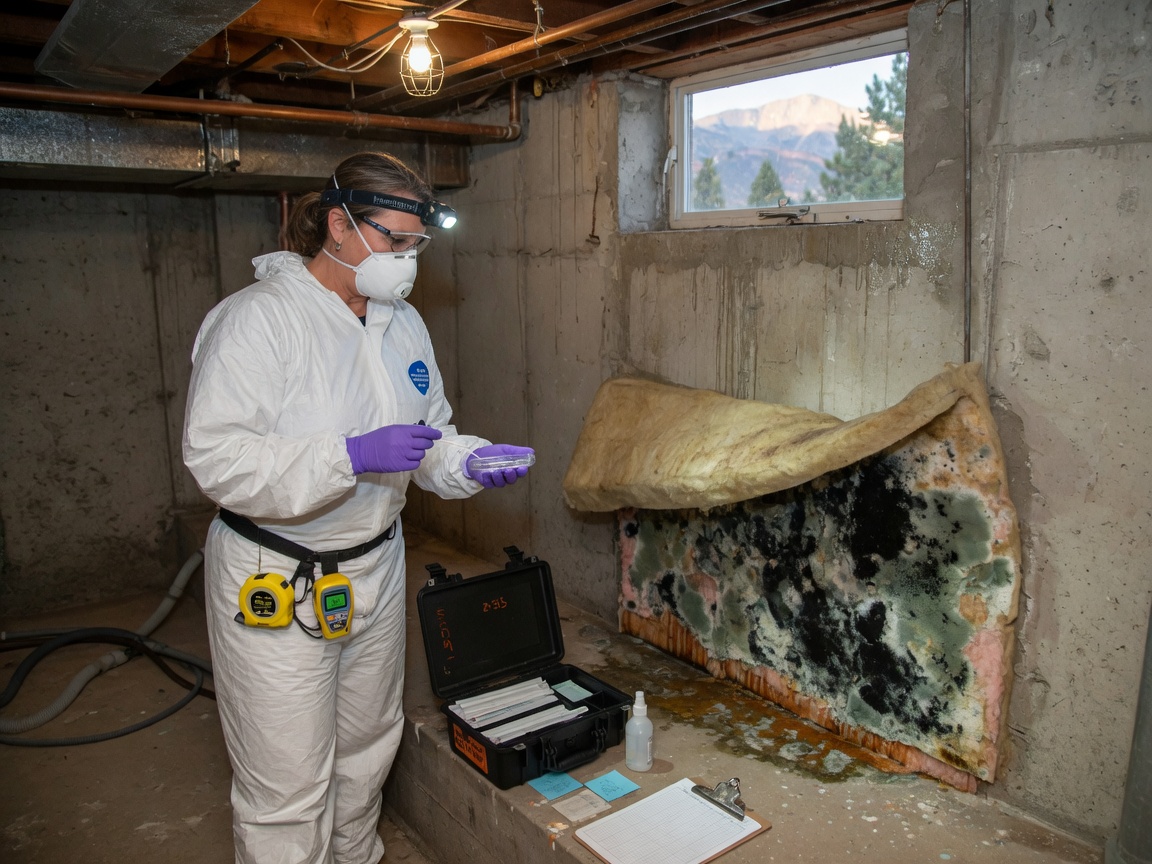
Colorado Springs homes built before 1980 in Old Colorado City and Manitou Springs often contain plaster and lathe walls plus stone foundations that trap moisture from snowmelt or pipe leaks. In the semi-arid high-plains climate, rapid winter temperature swings cause condensation inside wall cavities and attics, allowing mold to grow behind finishes without visible signs on the surface. A proper inspection uses moisture meters and thermal imaging to locate these hidden pockets before any remediation begins.
Flash flooding along creeks near Cheyenne Mountain and the United States Air Force Academy can push water into crawlspaces of Briargate and Rockrimmon properties. Once the water recedes, residual dampness in soil and insulation creates ideal conditions for mold within days. Testing protocols here include both air spore counts and surface tape lifts sent to accredited labs, because visual inspection alone misses the types of mold that affect indoor air quality in these neighborhoods.
Post-water-damage assessments must account for the cold winters that slow drying in unheated basements common in Fountain and Security-Widefield. Technicians document every sample location with photos and chain-of-custody forms so homeowners receive usable reports for insurance claims or real-estate transactions. Skipping this step often leads to repeated growth when summer heat returns and drives moisture upward through slabs.
Homeowners in Broadmoor and near the Olympic Training Center frequently request testing after roof leaks or ice-dam failures. The process distinguishes between allergenic and toxic species so remediation plans target only the affected materials rather than entire rooms. This targeted approach keeps costs down while meeting El Paso County health guidelines for habitable spaces.
Technician insight
In Colorado Springs the thing that catches most people out with Mold Inspection & Testing is older stone foundations in Manitou Springs and Old Colorado City that wick moisture from melting snow right up into sill plates during the freeze-thaw cycles; homeowners assume everything is dry once the surface looks normal, but the hidden growth starts weeks later when the cold air stops ventilating those spaces.
Broadmoor Crawlspace After Ice Dam
A homeowner in Broadmoor noticed musty air after an ice dam on the north roof. We mapped moisture in the rim joists, took air samples from the crawlspace and main floor, and found elevated Penicillium levels. The report guided targeted removal of wet insulation and improved ventilation rather than whole-house remediation.
Mold Inspection & Testing Services We Offer
✓Air Spore Count Testing
Collects indoor and outdoor air samples to measure mold spore levels and identify species common after water intrusion in Colorado Springs homes.
✓Surface Tape Lift Sampling
Removes material from visible or suspect surfaces for lab analysis, confirming active growth behind drywall or on framing in older Broadmoor properties.
✓Crawlspace and Attic Mold Inspection
Uses moisture meters and borescopes to check insulation and joists in Briargate and Rockrimmon homes where winter condensation often hides.
✓Post-Water Damage Assessment
Evaluates properties in Old Colorado City and Manitou Springs after pipe bursts or flooding to determine if mold remediation is required before drying.
✓Pre-Purchase Mold Screening
Provides buyers with documented findings for homes near Pikes Peak or the Air Force Academy where previous leaks may have gone unnoticed.
Mold Inspection & Testing Cost in Colorado Springs, CO
| Service | Typical Range | What Affects It |
|---|---|---|
| Basic Mold Inspection & Report | $275–$425 | Single-story homes under 2,000 sq ft, three samples |
| Multi-Level or Crawlspace Testing | $450–$650 | Additional samples and access time required |
| Pre-Purchase Screening | $350–$500 | Includes exterior and attic access points |
| Emergency After-Hours Assessment | $150–$250 | Added to base inspection when scheduled outside Mon–Fri 8-6 or Sat 9-2 |
Ranges are typical for Colorado Springs, CO and confirmed with an exact written quote before any work starts.
How it works
- 1
Site Walk and Moisture Mapping
Technician records visible stains, measures humidity, and uses infrared to locate damp areas in walls and floors.
- 2
Sample Collection
Air cassettes and surface lifts are taken from multiple rooms plus an outdoor control sample.
- 3
Laboratory Analysis
Samples are sent for spore identification and concentration counts with results typically available in 24-48 hours.
- 4
Written Report and Recommendations
Findings include photos, lab data, and specific next steps such as targeted drying or removal of affected materials.
Pricing
Pricing varies with square footage, number of samples, and whether the home is occupied or undergoing renovation.