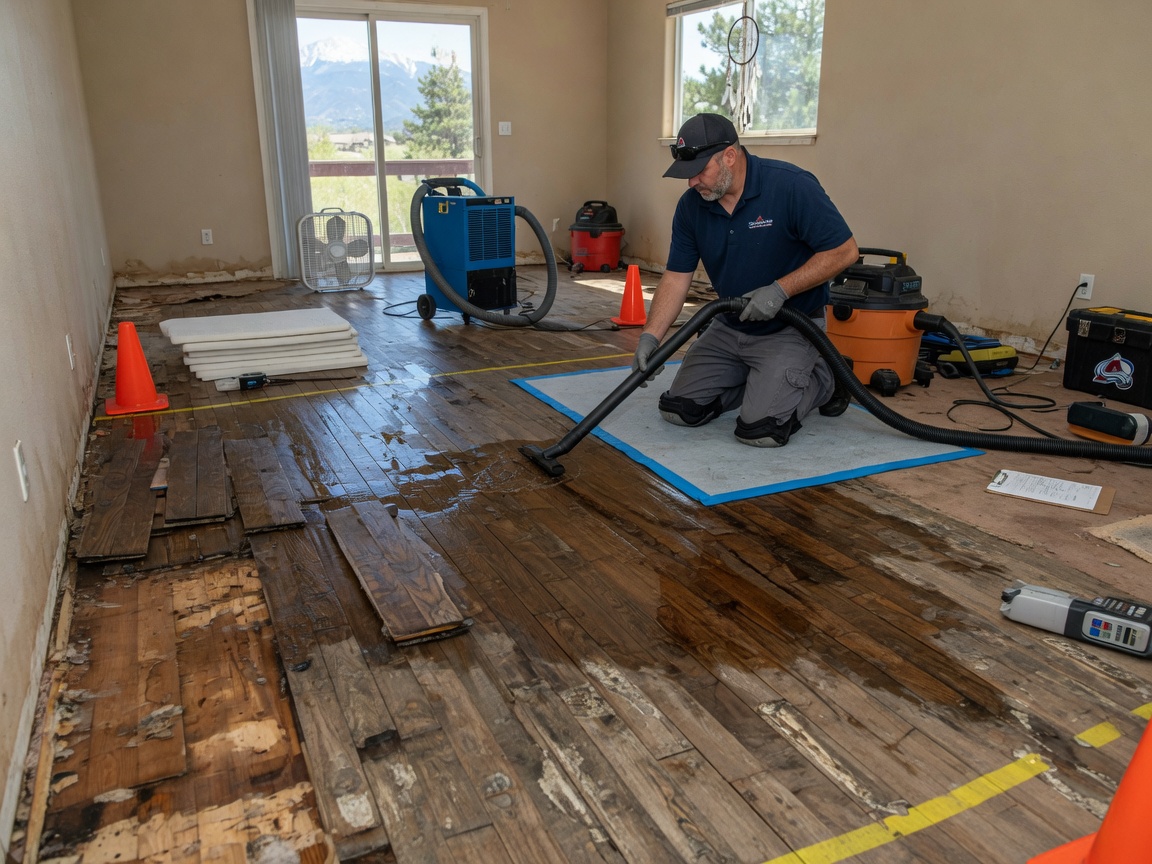
Homes built before the 1970s in Old Colorado City and Broadmoor often feature solid oak or maple flooring installed directly over crawl spaces or slab foundations common in El Paso County. When pipes freeze during cold high-plains winters or snowmelt infiltrates from Pikes Peak runoff, water travels under the boards and creates hidden pockets that promote cupping within days. Technicians must remove baseboards carefully to avoid damaging original trim, then use moisture meters calibrated for wood species to map saturation before any drying begins.
Semi-arid summers in Colorado Springs bring rapid evaporation on the surface while subfloor moisture lingers, especially in Briargate and Rockrimmon neighborhoods where many ranch-style homes have engineered wood layered over particleboard. This mismatch leads to edge swelling that standard fans miss. Restoration crews deploy low-grain refrigerant dehumidifiers paired with targeted air movers under the floor if access allows, monitoring relative humidity daily to prevent mold growth in the dry climate that still supports hidden colonies once moisture exceeds 16 percent.
Water events from nearby Fountain or Security-Widefield often involve category-two gray water that requires antimicrobial treatment on the wood without darkening the grain. Technicians sand only after the floor reaches equilibrium moisture content matching the ambient conditions around Cheyenne Mountain, typically 6 to 8 percent. Skipping this step causes finish failure within months when summer heat returns. All work stays within manufacturer guidelines for the specific flooring products installed in these El Paso County homes.
Technician insight
In Colorado Springs, the thing that catches most people out with Hardwood/Wood Floor Water Damage Restoration is assuming surface drying is enough after a winter pipe burst in Old Colorado City crawl spaces. The cold nights keep subfloor moisture high even when the boards look dry, and the sudden warm-up in spring makes cupping appear weeks later if we do not keep meters on the job.
Broadmoor Home After Frozen Pipe Event
A 1960s solid-oak floor in a Broadmoor residence absorbed water from a burst supply line during a January freeze. Meters showed 22 percent moisture under the boards while the surface read dry. Crews removed quarter-round, ran directed drying for nine days, then flattened and refinished the cupped sections to match the original patina.
Hardwood/Wood Floor Water Damage Restoration Services We Offer
✓Hardwood Floor Extraction and Drying
Removes standing water and deploys drying equipment calibrated for oak and maple floors found in older Colorado Springs homes to prevent long-term warping.
✓Subfloor Moisture Mapping
Uses pin and pinless meters to locate trapped moisture beneath wood floors in crawl-space homes common in Manitou Springs and Broadmoor.
✓Cupping and Warping Correction
Addresses raised edges caused by winter pipe bursts or summer irrigation leaks, then refinishes boards to match original grain in neighborhoods like Briargate.
✓Engineered Wood Restoration
Treats delaminated layers in newer Rockrimmon homes without full replacement, restoring stability after water intrusion from roof or appliance leaks.
✓Wood Floor Antimicrobial Treatment
Applies EPA-registered products safe for hardwood to inhibit mold after gray-water events common in El Paso County properties.
Hardwood/Wood Floor Water Damage Restoration Cost in Colorado Springs, CO
| Service | Typical Range | What Affects It |
|---|---|---|
| Initial Moisture Assessment | $150–$300 | Varies by number of rooms and access to crawl spaces in older homes. |
| Equipment Drying Package | $400–$900 | Daily rate for dehumidifiers and air movers until equilibrium is reached. |
| Cupping Repair and Sanding | $6–$12 per sq ft | Includes finish restoration; higher for solid oak in historic districts. |
| Full Board Replacement | $12–$25 per sq ft | Required when warping exceeds correction limits or subfloor damage exists. |
Ranges are typical for Colorado Springs, CO and confirmed with an exact written quote before any work starts.
How it works
- 1
On-Site Assessment
Technicians inspect the affected rooms, test multiple wood species for moisture content, and identify the water source while documenting conditions in the specific neighborhood.
- 2
Water Removal and Containment
Standing water is extracted and barriers are placed to protect unaffected areas before drying equipment is positioned under and around the flooring.
- 3
Targeted Drying and Monitoring
Daily moisture readings guide equipment adjustments until the floor and subfloor reach equilibrium with Colorado Springs ambient humidity levels.
- 4
Repair and Finish Restoration
Cupped boards are flattened or replaced as needed, then sanded and resealed to restore appearance and protect against future moisture in the dry high-plains climate.
Pricing
Upfront quotes provided after inspection; final cost depends on square footage, depth of saturation, and whether subfloor repairs are needed.